
WELCOME BONUS 300%
UP TO €2000 + 100
FREE SPINS
UP TO €2000 + 100
FREE SPINS
Home → Games
Casino games at Tiger Casino
Taking Insurance: The Most Common Blackjack Mistake
Blackjack Insurance carries a house edge of 7.47% with an RTP of just 92.53% when 6 to 8 decks are in play. The side bet allows a stake of up to 50% of the main bet when the dealer shows an ace. Basic strategy always declines this bet for players who are not counting cards.
The payout for Insurance is 2:1, which sounds attractive until the underlying probability is examined. With a single deck the edge is approximately 5.88%, still far worse than the main blackjack game. Only card counters at a true count of +3 or higher should consider taking this separate side bet.
The main blackjack game with 6 decks, S17, DAS, DOA and a 3:2 payout returns 99.54% RTP with a house edge of 0.46%. Insurance therefore costs a player roughly 16 times more on average than the main game. A player betting €10 on the main hand and €5 on Insurance gives the casino an expected value of about €0.37 from the side bet alone.
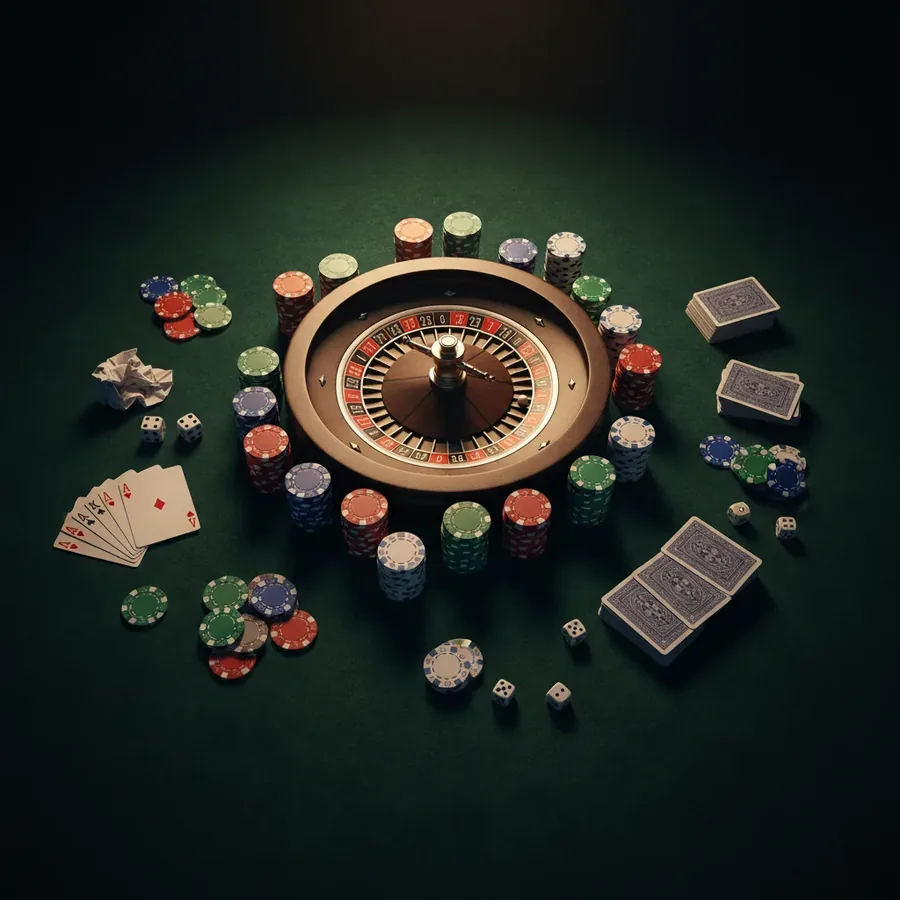
35:1 Instead of 36:1: Where the House Edge Comes From
A Straight bet in Roulette French pays 35:1, while the wheel has 37 pockets including the zero. If the payout were 36:1, the game would be exactly fair, because a player covers one number out of 37 possible outcomes. The missing unit is the origin of the casino's advantage on inside bets.
Roulette French inside bets without La Partage return 97.30% RTP with a house edge of 2.70%. The same house edge applies to Split 17:1, Street 11:1, Corner 8:1 and Six Line 5:1, because the payout shortfall remains one unit out of 37. Even-money bets with La Partage improve to 98.65% RTP.
Roulette American has 38 pockets because it adds a double zero, while paying the same Straight 35:1. The house edge rises to 5.26% with an RTP of 94.74%, almost double the European level. A player staking €100 on a Straight in American roulette loses €5.26 on average, against €2.70 in French roulette without La Partage.
Three Roulette Variants and Their House Edges
Roulette French with La Partage returns 98.65% RTP and a house edge of 1.35% on even-money bets such as Red/Black, Pair/Impair and Manque/Passe. When the zero hits, half the stake is returned to the player. En Prison offers the same 1.35% by holding the stake for the next spin instead of an immediate return.
The La Partage rule does not cover Straight 35:1, Split 17:1, Street 11:1 or Corner 8:1, so these bets stay at the European level. A player choosing inside bets gives up the benefit of the zero rule entirely.
Roulette American with a double zero and 38 pockets returns 94.74% RTP with a house edge of 5.26%. The extra pocket doubles the house edge compared with the European wheel while payouts remain the same. Over €100 of even-money stakes, French roulette with La Partage costs €1.35 on average, against €5.26 on the American wheel.
Multi-Hand Blackjack: Up to 5 Hands
Multihand Blackjack allows a player to split one starting hand into up to 4 hands, while a separate mode with up to 5 hands means playing five independent boxes against the same dealer hand. Doubling after a split improves RTP by about 0.14 percentage points. Resplitting aces improves it by 0.08 percentage points.
Dealer hitting soft 17 lowers RTP by 0.22 percentage points, making H17 a meaningful disadvantage. Six decks instead of 8 improves the figure by about 0.02 percentage points. The baseline game with 6 decks, S17, DAS, DOA and a 3:2 payout returns 99.54% RTP with a house edge of 0.46%.
Split aces usually get one card each, and doubling means a stake of x2 with exactly one additional card. A player who splits to the maximum of 4 hands multiplies total exposure by four, so the house edge applies to the combined stake. The 6:5 blackjack payout instead of 3:2 adds 1.39 percentage points to the casino's edge, which outweighs any rule improvement.
Game categories at a glance
| Category | Examples | Stakes From | Highlight |
|---|---|---|---|
| Slots | Buffalo Power: Hold and Win, Esqueleto Explosivo 2, Mega Moolah | 0.10 EUR | thousands of titles |
| Table games | Roulette, Blackjack, Baccarat | 0.50 EUR | classic rules |
| Live casino | Dream Catcher, XXXtreme Lightning Roulette | 0.20 EUR | real dealers |
| Jackpot games | Mega Moolah, Divine Fortune, Age of the Gods | 0.20 EUR | progressive pools |
| Instant games | Aviator, Plinko, Mines | 0.10 EUR | fast rounds |
| Video poker | Jacks or Better, Deuces Wild | 0.25 EUR | strategy based |
American Roulette: 5.26% Because of the Double Zero
American Roulette runs on 38 pockets: the numbers 1 to 36 plus 0 and 00. The double zero is the only structural difference from the European wheel, and it raises the house edge to 5.26%, which is exactly double the 2.70% edge of the single-zero game. A player staking €100 on straight numbers can therefore expect to lose €5.26 on average, against €2.70 on the European version.
Payouts stay identical across both wheels, so the extra pocket is not compensated anywhere in the pay table. A straight number pays 35:1, a split 17:1, a street 11:1, a corner 8:1 and a six line 5:1, exactly as on the 37-pocket wheel. The player receives the same return for a bet that now covers one pocket fewer in percentage terms.
Even-money bets carry the same penalty: red or black, odd or even, and low or high all pay 1:1 while the 00 reduces the RTP to 94.74%. For a beginner comparing the two wheels, the practical translation is simple: 100 rounds at €1 each cost about €5.26 on the American layout instead of €2.70 on the European one.
Split, Double, and Surrender: Three Decisions Explained
Splitting divides a pair into separate hands, and in the standard six-deck game a player may split up to four hands; doubling doubles the stake and receives exactly one additional card. Doubling after a split is allowed under the DAS rule and improves the return by about 0.14 percentage points, while resplitting aces adds roughly 0.08 percentage points. No surrender is offered in this game.
The combined effect of these rules is measurable. The six-deck game with S17, DAS, DOA and a 3:2 blackjack payout returns 99.54% with a house edge of 0.46%, but only when basic strategy is applied to every decision. Dealer hits on soft 17 instead lowers the RTP by 0.22 percentage points, which is the largest single rule penalty after the payout change.
A beginner weighing a €10 bet can see the stakes clearly: a blackjack at 3:2 pays €15, while the same hand at 6:5 pays only €12. That three-euro gap per blackjack is why the 6:5 version returns 98.15% and carries a 1.85% house edge. The surrender option does not exist here, so every hand is played to a win, a loss or a push.
37 vs. 38 Sectors: One Zero Difference
The European wheel holds 37 pockets, numbered 1 to 36 plus a single zero, and returns 97.30% on inside bets when La Partage does not apply. The American wheel adds the double zero for 38 pockets and drops the same bets to 94.74%. The gap between the two, 2.56 percentage points, comes from one additional pocket and nothing else.
On the European layout the inside payouts are a straight 35:1, a split 17:1, a street 11:1, a corner 8:1 and a six line 5:1, and the dozen and column bets pay 2:1. La Partage only covers even-money bets, where it returns half the stake when zero lands and lifts the RTP to 98.65% with a 1.35% edge. Inside bets never receive that refund, which is why they stay at 97.30%.
The practical difference for a beginner is visible per 100 rounds. At €1 per round, the single-zero wheel costs about €2.70 on average and the double-zero wheel about €5.26, so the second layout takes almost twice as much. Choosing between 37 and 38 sectors is therefore the single most important roulette decision before any bet type is picked.
Columns and Dozens Pay 2:1 in Roulette
A column bet covers twelve numbers in a vertical line and a dozen bet covers twelve numbers in a block, and both pay 2:1. These are outside bets, so they sit next to the even-money options such as red or black, odd or even, and low or high, all of which pay 1:1. A €10 dozen bet returns €20 in profit when one of its twelve numbers lands.
The coverage explains the price. Twelve of 37 pockets is roughly one third of the wheel, and 2:1 is the payout that matches that share before the house edge is applied. On the European wheel the RTP of these bets is 97.30% with a 2.70% edge, while the American wheel with its 38th pocket reduces the same bets to 94.74% and a 5.26% edge.
The same 2:1 applies to column bets on both layouts, so the choice between them is purely a matter of which twelve numbers a player prefers to cover. For a beginner, a single €10 dozen bet puts twelve pockets in play at once, against one pocket for a €10 straight bet that pays 35:1. Neither bet changes the underlying house edge of the wheel.
Hold or Discard: Deciding on Five Cards
Video Poker Jacks or Better 8/5 carries an RTP of 97.29% and a house edge of 2.71%. That edge means for every 100 € staked the casino keeps 2.71 € on average over the long run. The short pay table is the reason: a Full House pays 8 and a Flush pays 5, instead of 9 and 6 on the full-pay version.
The full-pay Jacks or Better 9/6 reaches 99.54% RTP with optimal strategy, a difference of 2.25 percentage points. Cutting just two payout units on Full House and Flush costs exactly that gap. A player wagering 100 € loses 2.71 € on the 8/5 table compared with 0.46 € on the 9/6 table.
Intermediate pay tables show how each unit matters: 9/5 returns 98.45%, 8/6 returns 98.39%, 7/5 drops to 96.15%, and 6/5 sinks to 94.99%. The Royal Flush pays 800 for one coin, Straight Flush 50, Four of a Kind 25, Straight 4, Three of a Kind 3, Two Pair 2, and Jacks or Better 1. The decision to hold or discard is driven by these values.
The Four Decisions in Every Blackjack Hand
Blackjack Single deck with classic rules and a 3:2 payout returns 99.85% RTP, leaving a house edge of just 0.15%. Fewer decks lower the edge, and one deck gives about −0.48 percentage points compared with 8 decks. That edge is often offset by a 6:5 payout instead of 3:2.
The 6:5 payout on a 6-deck game pushes RTP down to 98.15% and the house edge up to 1.85%. On a 10 € bet a blackjack pays 12 € instead of 15 €. Replacing 3:2 with 6:5 adds exactly +1.39 percentage points to the casino's edge, more than any other rule change.
Blackjack 6 decks with S17, DAS, DOA and a 3:2 payout achieves 99.54% RTP with basic strategy, a house edge of 0.46%. Dealer stands on soft 17, doubling after a split is allowed, and doubling down is permitted on any first two cards. Insurance is a separate side bet at 2:1 that basic strategy always declines.
How a Blackjack Hand Plays Out: Cards, Decisions, 3:2 Payout
A blackjack win pays 3:2 on the main bet, so a 10 € stake returns 15 € in profit. The regular win pays 1:1, and insurance pays 2:1 when the dealer shows an ace. Blackjack 6 decks with S17, DAS, DOA and basic strategy reaches 99.54% RTP, a house edge of 0.46%.
Doubling after a split improves RTP by about 0.14 percentage points, and resplitting aces improves it by 0.08 percentage points. Dealer hitting soft 17 lowers RTP by 0.22 percentage points. Six decks instead of 8 gives about 0.02 percentage points. A double means staking twice the amount for one card.
The 6:5 payout on a 6-deck game cuts RTP to 98.15% and raises the house edge to 1.85%. That +1.39 percentage point change exceeds all other rule effects. Blackjack Single deck with 3:2 and classic rules keeps the edge at 0.15%.
Jacks or Better: Check Payout Table Before Betting
Jacks or Better 8/5 shows a short pay table with RTP of 97.29% and a house edge of 2.71%. Full House pays 8 and Flush pays 5 per coin. The Royal Flush bonus of 4,000 requires the maximum bet of 5 coins on the full-pay 9/6 version.
The full-pay Jacks or Better 9/6 with optimal strategy returns 99.54% RTP, a house edge of 0.46%. Standard deviation is 4.42. The difference between 8/5 and 9/6 is 2.25 percentage points of RTP. A player staking 100 € loses 2.71 € on 8/5 versus 0.46 € on 9/6 on average.
Other pay tables fall further: 9/5 returns 98.45%, 8/6 returns 98.39%, 7/5 drops to 96.15%, and 6/5 reaches only 94.99%. Payouts for one coin are Royal Flush 800, Straight Flush 50, Four of a Kind 25, Straight 4, Three of a Kind 3, Two Pair 2, Jacks or Better 1.
The 9/6 Paytable: Nine for a Full House, Six for a Flush
The 9/6 video poker table pays 9 for a Full House and 6 for a Flush per 1 coin. Jacks or Better 9/6 with optimal strategy reaches 99.54% RTP and a house edge of 0.46%. The Royal Flush pays 800 for one coin, or 4,000 for a maximum bet of 5 coins.
Compared with the short-pay 8/5 table, the 9/6 version returns 2.25 percentage points more. The 8/5 game holds 2.71% of each stake, while 9/6 holds only 0.46%. On 100 € staked the expected loss is 2.71 € on 8/5 versus 0.46 € on 9/6.
Intermediate tables show gradual decline: 9/5 returns 98.45%, 8/6 returns 98.39%, 7/5 drops to 96.15%, and 6/5 sinks to 94.99%. Standard deviation on 9/6 is 4.42. Straight Flush pays 50, Four of a Kind 25, Straight 4, Three of a Kind 3, Two Pair 2, Jacks or Better 1.
Contact
Live - online chat
Banking









Providers












Tiger Casino 2026